Pages

Showing posts with label altered objects. Show all posts

1.30.2014

Lee Bonetcou


I am not sure how or why I never learned about this incredible artist when I was in art school and the more art I seem to "discover" on my own makes me more and more angry about the canon of art excluding and without  mention absolutely incredible women artists. But before I launch any further into a rant about the gaping holes in the canon of western art let's meet Lee Bontecou.


Lee Bontecou was a very successful artist in the late 1950's and the 1960's. She was represented by New York Galleries and her shows consistently sold out. Much of her work is in permanent collections in places like New York, Washington, Chicago, and San Francisco. She disappeared from the gallery world after her daughter was born, teaching at Brooklyn College and working in solitude and isolation for nearly thirty years. A retrospective of her work both the early sculptural work and her later works on paper was exhibited at the Hammer Museum in LA in 2003. The show later travelled to MOCA in San Francisco and to MOMA in New York in 2004.


In the early part of her career she worked mainly in sculpture creating massive pieces which project off the gallery wall toward the viewer. She combines traditional materials of painting, canvas and her pieces hang on the wall like a traditional painting but they are anything BUT traditional. Her pieces include welded and stitched canvas and hide which feel industrial and mechanical yet organic in a terrible haunting sort of way. Each piece contains at its centre a vortex completely void of light – literally a black hole.

She was greatly influences by the trauma of World War 2 and later by space exploration and the world of astronomy but she refuses to label herself or her work. It is very clear that she doesn't care what you think of her work and struggles against anyone who may try to define it.

Lee Bontecou just celebrated her 83 birthday and is still working away in her studio doing whatever the hell she pleases, no doubt. I will leave you with a quote that struck me as vital to understanding the creative process:

"[Drawing] can get your imagination moving and you can work from your inner world rather than always from the external world"

Soot Drawing 1958

 You read more about this incredibe artist and her work here and to see more of her work do a google image search or type her name into Pinterest

Have a look at her work and share your thoughts and comments below.


12.28.2013

Ronald Ceuppens

I have found many new artists to explore from perusing the amazing things posted on Pinterest. I never expected it would become such a source of inspiration for me and my work. I have discovered a handful of incredible print artists there in the last little while and I am excited to share them with you.

The first one is Ronald Ceuppens, a Belgian printmaker. Unfortunately for me, his site is in Belgian and I cannot quite grasp the exact impetus for his work but that hardly matters once you see it. I am particularly interested in the arrangement of print fragments and collage elements in his "collections". I am also fascinated by his mixed media work about children.

His work is excellently crafted and evokes a sense of memory or dream although the results are often unsettling. I am drawn to the Dreamchild object, what appears to be a doll body encased in leather with ceramic branches for arms. It is unclear if this "child" is a memory or manifestation of birth or death or a physical representation of an imagined spirit.

Many of the pieces below are available in Ronald's Etsy Shop Fleurografie. I highly recommend having a look at the work he has posted there. If you would like to see more of Ronald's work be sure to visit his blog.


I discovered this little description in English on his blog though I am unsure of the source:

He likes long walks, hiking in the mountains or simply exploring the city. The itineraries of his walks are found in his work, reduces to their abstract form. Using sketches, drawings and objects collected during his walks, Ronald makes the designs for his prints. Reproduced in a repetitive manner they give rise to serial work in which each work speaks individually. The reconstructions of images made up of such fragments is a way of preserving the memory of a place The artist manages to translate nostalgia for the past into a search for future pleasure. Ronald Ceuppens creates an abstract world, filled with the sensitive melody of silence and serenity.

8.27.2013

Heather Benning, firestarter.


I found out about Heather Benning's Doll House project only after she set fire to it. I stumbled across the CBC story quite by accident but I am glad I did. Unfortunately I didn't get a chance to see the project in real life though there are a number of You Tube videos documenting it. The initial project converted an old farm house into a life sized version of a doll house. The house was open to view through plexiglass on one side and filled with ephemera from the 1960s. If you happened across it in the middle of the prairie it might appear as if the occupants had perhaps fled from it. The house stayed exactly as Benning (re)created it for nearly six years.


I am unsure why it was burned down instead of torn down though I do really like the idea of fire erasing it from the landscape. It seems to me to be a more authentic and natural form of erasure than tearing it down or letting it be destroyed by vandals. It is interesting too that fire isn't necessarily something one associates with a doll house so to set fire to a representation of childhood seems to also imply something a bit dark. I like that.  

If you have been following this blog for a while then you know how much I love narative projects. Whether the narrative is implicit or implied I love being able to imagine countless scenarios for a particular piece of work. I suppose this work allows me to imagine two separate bnarratives; the house as a museum on the prairie and the motivation and spectacle of a house fire.

I love imagining the people who may have lived there; What did they do? What celebrations and tragedies did they experience during their time in the house? Where did they come from? Where did they go? What sorts of secrets are hidden in the walls?

The Dollhouse is like a three dimensional memory. It makes me think of a half remembered dream you could re-visit over and over but access to specific and tactile information is denied by the plexiglass – much like one feels days after an intense dream. The Dollhouse project was also really interesting for me because I grew up on the prairies. My grandparents house was a lot like a museum; there were many artifacts kept alive within the walls of that prairie house. Pioneer spirits seemed to be content to lie quietly inside closets and in boxes tucked away under beds and and in basements.


Heather Benning captured perfectly the prairie life and preserved it for passersby and pilgrims who traveled out of the city to recollect a piece of Canada's past. Her new work continues to explore memory, landscape and the idea of home. You can see more of her work on her website heatherbenning.ca


3.05.2013

Diana Thorneycroft

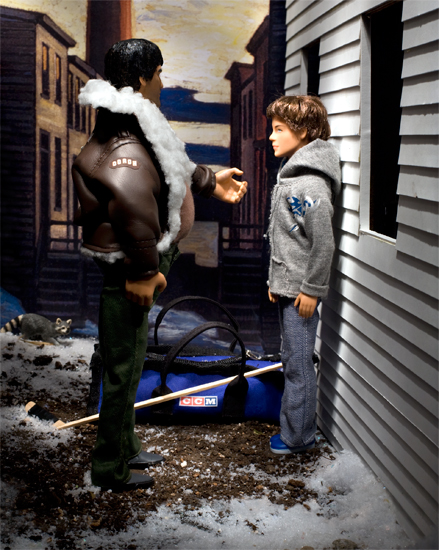
Diana Thorneycroft is a Canadian artist who re-imagines and creates dioramas of Canadian history. I love her work as it is not only brilliant in its conception but is also simultaneously hilarious and heartbreaking. Her work is like laughing as the love of your life stabs you to death.

Her series The Group of Seven Awkward Moments are little gems of wit and Canadian culture each staged in front of a different Group of Seven Painting. She describes her work as follows:

It is through the use of the collective's iconic northern landscapes, which have come to symbolize Canada as a nation, combined with scenes of accidents, disasters, and bad weather that gives the work its edge. By pairing the tranquility of traditional landscape painting with black humour, the work conjures up topical and universally familiar landscapes fraught with anxiety and contradictions.


Her series that follwed The awkward moments was much darker and effectively opens the skeletal closet of the Canadian collective consciousness. The content for A People's History relates directly to a current or historical event and exposes the dark evils that lurk at the periphery of our history books. I may have been much more interested in learning history while in school if discussions about the issues found in Thorneycroft's work were introduced and even more interested if we'd udes her work to initiate discussion. While it is fine to read about the "facts" as we all know history is written by the victor and therefore many stories go unrecorded. She describes the ongoing series:

With some of the research however, it became apparent the word “awkward” was not applicable. The horrors that took place in First Nations residential schools and orphanages like Mount St. Cashel, Newfoundland, speak of atrocities that eradicate all humour. 

I am in the process of completing the “atrocities” and working towards an exhibition entitled “A People’s History”. The series is about horrific events committed in Canada against our most vulnerable citizens; the disadvantaged, the uneducated and the young. At the time of each violation the victims were either ignored, disbelieved, or considered expendable.

Thorneycroft's work is an interesting form of documentary, capturing imagined events with dolls as if recreating the events for a therapist. Perhaps her work is a therapeutic form in which we all can participate as each of these events leaves an indelible impression on us as Canadians and how we see ourselves.