Pages

Showing posts with label fibre. Show all posts

8.11.2014

Nastasja Duthois embroidery magic


Embroidered Silhouettes by Nastasja Duthois


Embroidered Silhouettes by Nastasja Duthois silhouettes embroidery
Artist Nastasja Duthois creates large installations and small-scale embroidered artworks that explore aspects of shadow and negative space. Though composed of thousands of straight sewn lines reminiscent of crosshatching, the final pieces are generally organic in form from the silhouettes of dogs and animals to more complex landscapes. You can see more of her work over on BASE and on her website. 

8.06.2014

Lyndie Douthe


I found artist Lyndie Douthe on Pinterest. I know I know you're starting to think I have an addiction or something. I was struck by the delicacy and subject matter. Severed fingers, tiny love letters, anatomical bits, illness, rotting fruit complete with flies, and skeletons don't seem to be common subjects for fibre artists.

I absolutely love being surprised by work that doesn't fit a mold or into one of my preconceived notions of what it is. By now you all know I love the dead things, anatomy, and boxes of bones but these objects were just so delightfully unusual that I had to share them.

Lyndie Douthe's website showcases her work and I love being able to get a look at another artists' process. I also love being able to see the evolution of her work over the course of a few years. It is a different take on the memento mori theme both in subject matter and from a craft that is historically and canonically dominated by women. Her website  contains her blog, written in French where she talks about her work and travels and documents the process behind her creations as well as a store where you can purchase something that tickles your fancy or request a custom piece. I have my eye on the "broken" hearts and just might have to order me one!

You can read more about her (in English) here.

What are your thoughts?


3.31.2014

Animal Threads of Artist Ana Teresa Barboza

I am not yet very good at reading Spanish but I get the feeling from her work that Ana Teresa Barbosa is interested in the body and animals. Her works are mostly created by embroidery on linen but her subject matter is anything but traditional.

I first saw her work posted on twitter as a woman putting her head into the mouth of a lion. When I opened the image I realized the entire lion was embroidered and after that I just had to know more and when I got to her website there were so many pieces that intrigued me I knew I had to feature her work on the Paper Coyote.


 There are so many aspects of her work that I find interesting and the most difficult part of all is not being familliar enough with Spanish to be able to read  the description on her blog but the bits and pieces I can cobble together from the patchy Google translate indicated that Ana is indeed another artist interested in the relationships between animals and humans.

She seems to take a different approach to her theory and from what I can sort of understand is that she sees the idea of "wild" as a collective Jung-ian dream, some vestage of a memory of when we ourselves were less civilized. and looking at her work it seems obvious that we are the vessels in which the dream of the wilderness is made real. The humans are all simple "empty" drawings in black and white and our true animal nature manifests when we behave in ways that activate that dream and connect us back to the animal part of ourselves: hunting, eating, or mating.

There is struggle present as well depicted in literal wrestling matches or in the act of trying to remove a kitten from your nose. I can't say for sure by I interpret that struggle as a representation of the frustration at species being unable to communicate and the never ending jostling for domination and dominion.

Check out her website and if you speak Spanish please feel free to leave a comment in the comment section if you can elaborate on her theories or artist statement. (comments are moderated to prevent spam so don't panic if you don't see it right away)

You can see more of her work and read about it on her blog.


2.16.2014

Barbara Heller's Dead Bird Tapestries

I love discovering new artists and despite living in an isolated community with a less than interesting art section at the local library and no public art galleries I seem to find ways to stay connected to the art world. Whether it is through Galleries West Magazine, stumbling through Pinterest or having someone share something with me via Facebook I am constantly inspired by my fellow creators, especially the ones that stray into the realm of morbid decay.


I grabbed a copy of Galleries West Magazine after running a workshop at the local artist community centre and as I flipped through it I happened to see an advertisement for Barbara Heller's show. At first the image didn't register but when I looked again and the threads wove themselves together I was astonished and excited to see more.

Of course I immediately did a search for more images of her work hoping so much that this wasn't a one off. And I wasn't disappointed. I discovered a handful of boldly coloured tapestries with delicate images of dead birds which happens to be one of my favourite subjects.

I find Heller's work interesting on a number of levels. First I love the images, the placement and the fine line work that seems to appear and disappear from the surface. I can't even imagine how difficult it must have been to plan out and create an image with such subtle detail, as if she planned out every single stitch. The delicacy of the decay she evokes in the surface is incredible and I imagine that from afar for just a moment one might mistake them for paintings or drawings.

Secondly I love the ideas that seem to merge in her work. Without having read anything about the artists intention I think of things like death shrouds and historical records, hunting tapestries and flannel sleeping bag linings. I want to imagine these as patterns for some reason.

I look forward to seeing more of this work and secretly hope she stitches up a few more animals.

You can see more of Barbara's work on her website.


2.25.2013

Janice Wright Cheney


If you have only recently discovered this little gem of a blog then you may not know the affinity I have for coyotes and taxidermy. Any time I see an artist using coyotes or coyote forms or any taxidermy "ephemera" really, I sometimes develop a little art crush. I usually end up spending a couple hours exploring an artists website and making notes and then in most cases, they end up posted here. and again, I have stumbled or linked my way to the amazing and incredible Janice Wright Cheney. 

I think I have mentioned my affinity for coyotes and animals and taxidermy. Janet's work is interesting because while her wolves/coyotes sometimes look more like weimaraners than wild animals I think it is intentional because her work blurs the lines between wild and domestic, as well as gender.Much of Janet's work involves combining a traditionally female craft (embroidery, tatting, knitting) with a form that suggests masculinity: the taxidermy form. The foam "carcass" is dressed up in "female" attire complete with jewellry and false eyelashes. The wild animals seem far more domestic in their lacy scarves and fur which appears more of a fashion statement than as a representation of them in thier "natural" state.

It is interesting too that the ladies (which is a total assumption since we can't see all of their anatomy) are only half dressed either half skinned or half covered depending and when juxtaposed with the bones of the actual animals in small boxes much like museum specimens the question really does become about what remains. Placing these creatures out in a natural environment makes the question even more haunting.

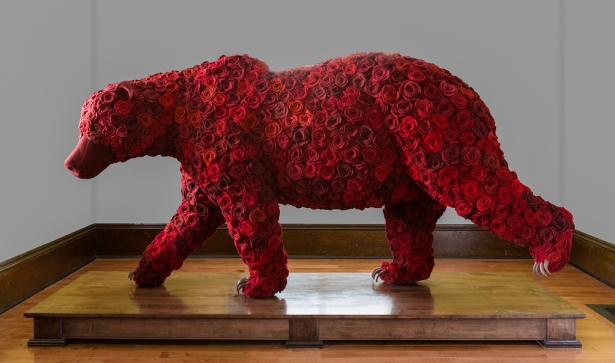
The felted flower covered bears are titled Widow and represent loss, grief and survival. A taxidermied bear is often posed in an aggressive stance speaking with some suggestion tot he prowess of the hunter who killed it. I have never seen a bear trophy mounted to depict a bear lost in thought or simply sitting and admiring its surroundings. These bears simultaneously represent the trophy, the monument, the conquer and yet something more delicate- a sadness, a memorial, a burial ritual. The flower covering the bears is a rose, hundreds of hand felted red, pink, and burgundy roses the flower of love. Generally the red rose is  symbol of romantic love and the title hints at this loss as well "widow" suggesting the loss of a husband. What fascinates me even more is that bears do not mate for life – they do not marry, they do not have the matrimonial bond of humans nor do they even co-habitate yet there is no questioning the love and bond between a bear and her cubs. And that leaves me wondering if there is a subtext at play that perhaps the bear has suffered a loss and is more than simply a momunment to the fear and conquer human trophy.