Pages

4.16.2014

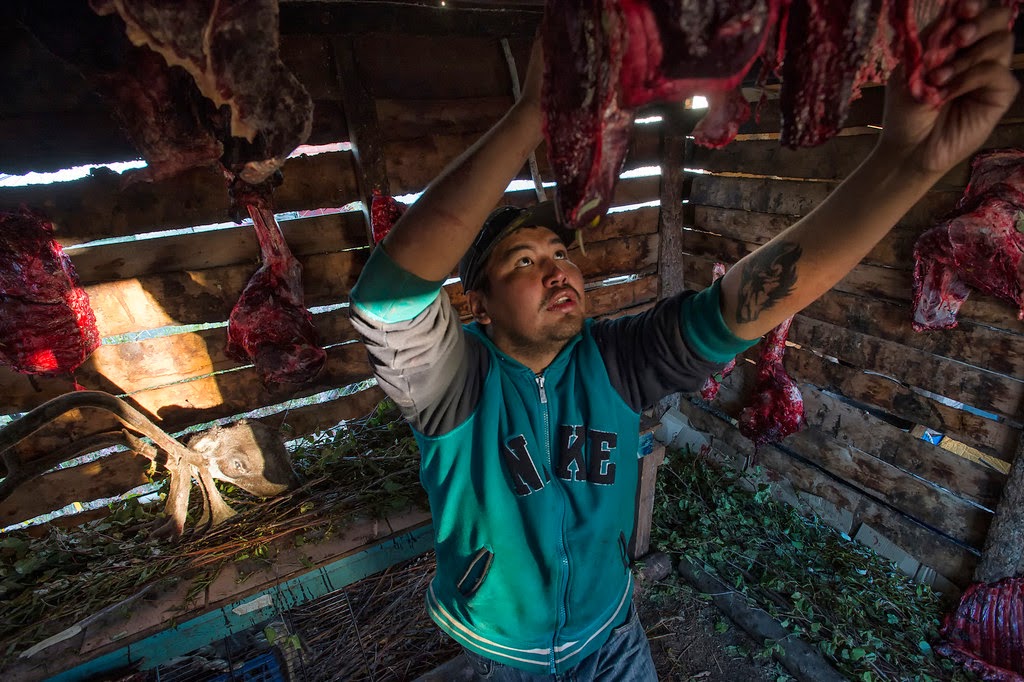
Peter Mather Documents a Changing Arctic

Peter Mather is a photographer from Yukon Canada who documents the land and people of this arctic territory. He describes his work as a hybrid of fine art photography and documentary photography and his images can be quite startling yet beautiful much like the arctic itself. The photos below are from Yukon, NWT, and Alaska.

http://www.petermather.com/PhotoStories/Stories/

Far from an icy wasteland, the arctic is a fragile yet unforgiving wilderness populated with resilient people, plants and animals that thrive in some of the most challenging conditions in the country. People in the arctic have a strong relationship with the land. The weather, the animals, and the hunt all feed into a strong emotional bond with the very ground under their feet. They are well aware of the richness and bounty of the arctic and with the demand for resources at an all time high, greed threatens to destroy this delicate balance. Peter Mather is there documenting these relationships, the land, the people, and all the other precious things that risk getting lost in the quest for more.

You can see more of his images on his website or contact him via his facebook page.


All images © Peter Mather

3.31.2014

Animal Threads of Artist Ana Teresa Barboza

I am not yet very good at reading Spanish but I get the feeling from her work that Ana Teresa Barbosa is interested in the body and animals. Her works are mostly created by embroidery on linen but her subject matter is anything but traditional.

I first saw her work posted on twitter as a woman putting her head into the mouth of a lion. When I opened the image I realized the entire lion was embroidered and after that I just had to know more and when I got to her website there were so many pieces that intrigued me I knew I had to feature her work on the Paper Coyote.


 There are so many aspects of her work that I find interesting and the most difficult part of all is not being familliar enough with Spanish to be able to read  the description on her blog but the bits and pieces I can cobble together from the patchy Google translate indicated that Ana is indeed another artist interested in the relationships between animals and humans.

She seems to take a different approach to her theory and from what I can sort of understand is that she sees the idea of "wild" as a collective Jung-ian dream, some vestage of a memory of when we ourselves were less civilized. and looking at her work it seems obvious that we are the vessels in which the dream of the wilderness is made real. The humans are all simple "empty" drawings in black and white and our true animal nature manifests when we behave in ways that activate that dream and connect us back to the animal part of ourselves: hunting, eating, or mating.

There is struggle present as well depicted in literal wrestling matches or in the act of trying to remove a kitten from your nose. I can't say for sure by I interpret that struggle as a representation of the frustration at species being unable to communicate and the never ending jostling for domination and dominion.

Check out her website and if you speak Spanish please feel free to leave a comment in the comment section if you can elaborate on her theories or artist statement. (comments are moderated to prevent spam so don't panic if you don't see it right away)

You can see more of her work and read about it on her blog.


3.03.2014

Mitsuko Nagone Visits the Zoo


I was struck by the heart-breaking photographs of zoo animals taken by Mitusko Nagone. As a kid I loved going to the zoo. It was always so exciting to see animals up close and the petting zoo was even better because you could actually physically connect with an animal. There is something ignited inside a person when they make that connection to an animal, the physical contact, the body heat, breath, wet-nosed nuzzle or even a sharp kick or nip or scratch all leave something in us changed.


For me I am unsure about what exactly I felt besides excitement when at the zoo but I think there was always some sort of unease, an uncomfortable feeling lingering that suggested something just wasn't quite right. I think that is exactly the moment, that latent childhood image that Mitsuko has captured. These images evoke that same uneasy and feeling as if she has drawn out that single frozen moment from our childhood memories when we could not yet articulate what felt wrong.

I imagine that I saw these images or others like them hundreds of times when walking around a zoo: an animal looking out from behind bars, pacing in it's cage, isolated and surrounded by concrete instead of earth. only now having them frozen in time and re-presented to me can I see what sort of horrors truly exist for the prisoners of many of these facilities.

With so many repeated atrocities occurring against animals around the world I wonder if I will ever live to see their liberation. Will I ever see animals like chimpanzees, whales, dolphins, ravens, or any of the other thousands of sentient beings offered their sovereignty, dignity, and freedom to live by their own will released from the domain of humans. I guess when I look at any work about animals I wonder about that.

Mitsuko Nagone grew up in a small southern city in Japan. She moved to Tokyo and studied photography at the College of Tokyo Visual Arts and then moved to New York City to continue her studies at LaGuardia Community College. Currently, Mitsuko resides in Tokyo, Japan, and works as a freelance photographer. Visit her website to see more of her work.


2.16.2014

Barbara Heller's Dead Bird Tapestries

I love discovering new artists and despite living in an isolated community with a less than interesting art section at the local library and no public art galleries I seem to find ways to stay connected to the art world. Whether it is through Galleries West Magazine, stumbling through Pinterest or having someone share something with me via Facebook I am constantly inspired by my fellow creators, especially the ones that stray into the realm of morbid decay.


I grabbed a copy of Galleries West Magazine after running a workshop at the local artist community centre and as I flipped through it I happened to see an advertisement for Barbara Heller's show. At first the image didn't register but when I looked again and the threads wove themselves together I was astonished and excited to see more.

Of course I immediately did a search for more images of her work hoping so much that this wasn't a one off. And I wasn't disappointed. I discovered a handful of boldly coloured tapestries with delicate images of dead birds which happens to be one of my favourite subjects.

I find Heller's work interesting on a number of levels. First I love the images, the placement and the fine line work that seems to appear and disappear from the surface. I can't even imagine how difficult it must have been to plan out and create an image with such subtle detail, as if she planned out every single stitch. The delicacy of the decay she evokes in the surface is incredible and I imagine that from afar for just a moment one might mistake them for paintings or drawings.

Secondly I love the ideas that seem to merge in her work. Without having read anything about the artists intention I think of things like death shrouds and historical records, hunting tapestries and flannel sleeping bag linings. I want to imagine these as patterns for some reason.

I look forward to seeing more of this work and secretly hope she stitches up a few more animals.

You can see more of Barbara's work on her website.


2.07.2014

Karin Ceelen

Another Pinterest discovery was Karin Ceelen who makes gorgeous, delicate etchings with intricate line work and subtle tone. I find her work compelling in its texture which remind me a lot of maps and geography. I love the cutout and layering as well which add richness and layers to the pieces. 

She is also a photographer and on her blog you can see the photographs that inspire her print work.

Comments are always welcome.